



1. The Sign Problem
Mr Ingvars Vitenburgs, Imperial College London, Department of Chemistry
Quantum many-body calculations are plagued by the notorious sign problem, which manifests in many ways, but mainly via an exponential computational cost scale. Here we have visualised, whilst also conducting studies of, the root of this problem using ARCHER2 - the complex, possibly even fractal, nodal surface, present in a system of 50 trapped electrons. The blue and red colours signify either sign of one of the electrons wavefunctions, whilst the white dots are the locations of the other 49 particles. The calculation of any physical property requires evaluating the contribution of both coloured regions, which is known to be computationally challenging.

2. Picture Showing the Synthesis of Ammonia on Manganese Nitride (Mn3N2)
Dr Constantinos D. Zeinalipour-Yazdi, Northeastern University London
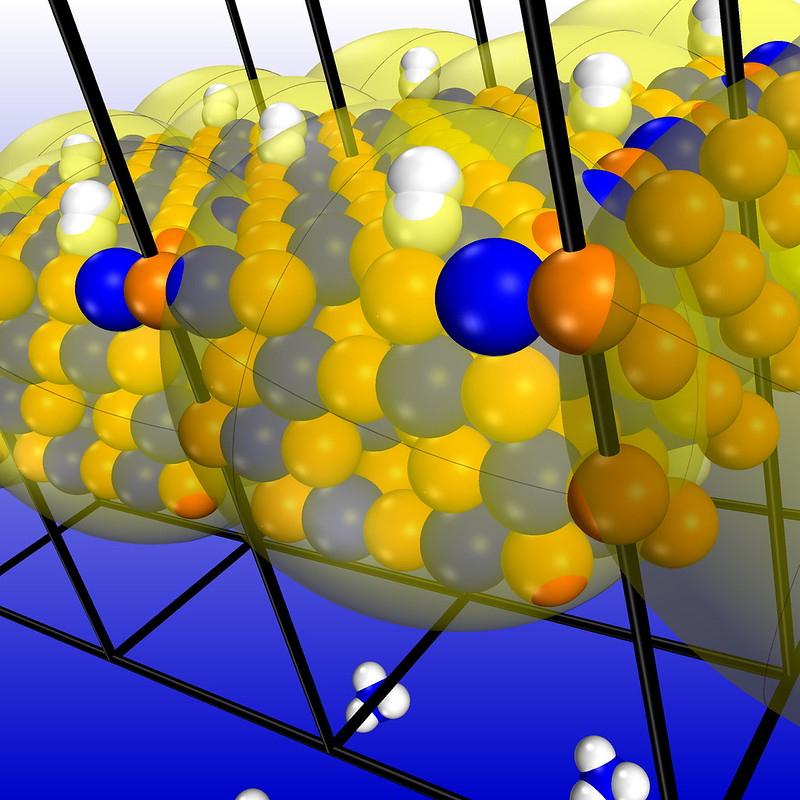
Understanding the mechanism of catalytic reactions is crucial for the future development of catalysts. In this computational study, dispersion-corrected Density Functional Theory (DFT) theory was used to calculate the various mechanistic pathways for ammonia and hydrazine synthesis on η-Mn3N2-(100) surfaces. A simple Lewis structure representation algorithm was used in order to locate various possible NxHy intermediates. Hydrogenation of dinitrogen results in significant activation of the inert triple bond and these intermediates have a significant role in the ammonia and hydrazine synthesis reaction on manganese nitrides via a Langmuir-Hinshelwood mechanism. It is anticipated that these findings are significant in developing new catalysts for hydrazine synthesis using η-Mn3N2(100) catalysts.
3. Picture Showing the Synthesis of Ammonia on Manganese Nitride (Mn3N2)
Dr Constantinos D. Zeinalipour-Yazdi, Northeastern University London
Understanding the mechanism of catalytic reactions is crucial for the future development of catalysts. In this computational study, dispersion-corrected Density Functional Theory (DFT) theory was used to calculate the various mechanistic pathways for ammonia and hydrazine synthesis on η-Mn3N2-(100) surfaces. A simple Lewis structure representation algorithm was used in order to locate various possible NxHy intermediates. Hydrogenation of dinitrogen results in significant activation of the inert triple bond and these intermediates have a significant role in the ammonia and hydrazine synthesis reaction on manganese nitrides via a Langmuir-Hinshelwood mechanism. It is anticipated that these findings are significant in developing new catalysts for hydrazine synthesis using η-Mn3N2(100) catalysts.

4. Picture Showing the Synthesis of Ammonia on Manganese Nitride (Mn3N2)
Dr Constantinos D. Zeinalipour-Yazdi, Northeastern University London
There is significant recent interest to investigate potential routes for ammonia synthesis in gas phase under plasma conditions. We have previously calculated the barriers for dinitrogen hydrogenation in gas phase and found that they are prohibitively high in the absence of a catalyst. However, the use of energetic electrons to produce radial cations in dinitrogen may result in the synthesis compounds under energetically more efficient conditions. This picture depicts on a hypothetical basis the reactants and products of such as gas phase reaction, in which the molecules are enclosed in their corresponding van der Waals surfaces.

5. Large Eddy Simulation of Ignition and Flame Propagation in a Lean-Direct-Injection Hydrogen Combustor
* * * Winning Video * * *
Caleb J. Li, University of Cambridge
Hydrogen is increasingly recognised as a critical component of future energy systems with reduced carbon emissions. However, safely and efficiently using hydrogen in engines and turbines remains challenging due to its high reactivity and distinct combustion characteristics compared to traditional fuels. By computationally modelling combustion, engineers can test ideas virtually without relying on costly or risky real-world experiments. This animation is from an ARCHER2 Pioneer Project carried out by researchers from the University of Cambridge investigating the use of hydrogen as a low-carbon fuel.
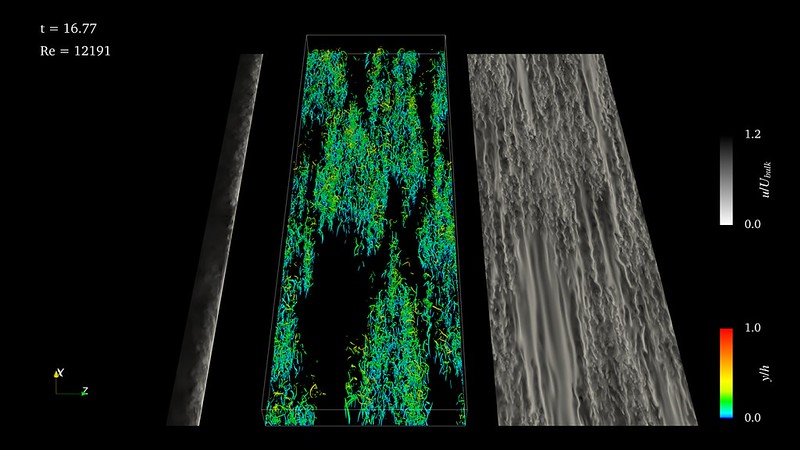
6. During temporal acceleration, vortical structures, visualised using the $\lambda_2$ criterion, and low-speed streaks exhibit non-uniform spatial distributions.
Zekun Ma, University of Cambridge
This research examines how turbulence responds when flow through a channel is linearly accelerated from a low Reynolds number state. Detailed computer simulations are used in which the flow rate increases steadily with time. The results show that turbulence does not respond immediately to the acceleration, but instead exhibits a clear delay. When new turbulence begins to develop, it is not distributed evenly throughout the flow but appears in highly localised regions. The image highlights this uneven development, showing vortical structures and low-speed streaks. By tracking these regions backwards in time, we find that the newly generated turbulence develops from elongated vortical structures aligned with the main flow direction. This study helps reveal how turbulence is generated and reorganised when a flow undergoes mild acceleration.

7. Blueprint of a Beat: The Heart’s Hidden Fibre Architecture
* * * Winning Image and overall competition winning entry * * *
Dr Abdallah Hasaballa, University of Oxford, Department of Computer Science
This image reveals the hidden structure that helps the heart beat efficiently. It shows a healthy control heart in two complementary ways: one half displays the three dimensional geometry of the ventricles, while the other half reveals the orientation of the cardiac muscle fibres. These fibres are arranged in a highly organised pattern and gradually rotate across the heart wall, from about +60 degrees at the inner surface, shown in dark blue, to about −60 degrees at the outer surface, shown in dark red. This smooth change in fibre direction is fundamental to how the heart contracts and twists to pump blood. Using large scale computer simulations on ARCHER2, we can visualise this architecture in detail and use it as a foundation for understanding heart function in both health and disease.
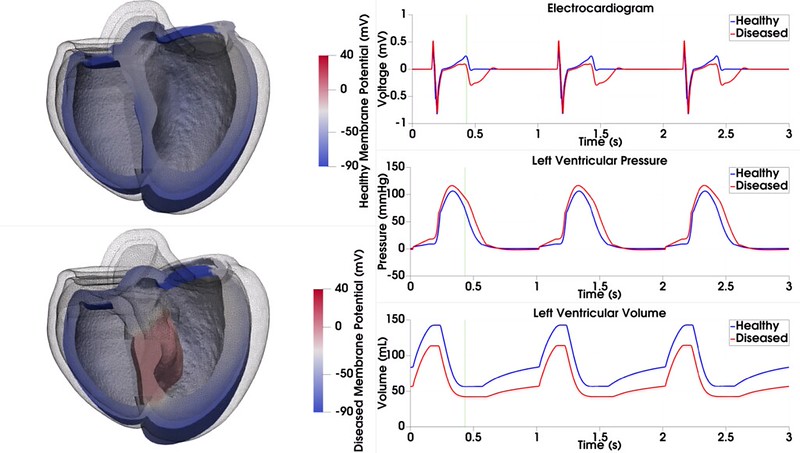
08. From Electrical Wave to Pumping Heart: Hypertrophic Cardiomyopathy in Motion
Dr Abdallah Hasaballa, University of Oxford, Department of Computer Science
This video brings together the electrical and mechanical behaviour of the heart to show how hypertrophic cardiomyopathy can alter its function. On the left, electrical activity spreads through three-dimensional models of a healthy heart above and a diseased heart below. On the right, the same simulations are reflected in the electrocardiogram, the pressure generated inside the left ventricle, and the changing volume of blood as the heart fills and pumps. Healthy behaviour is shown in blue and diseased behaviour in red. By viewing these signals together, we can see how changes within heart cells and tissue can influence the electrical activity of the whole heart and its ability to pump blood. Large-scale simulations on ARCHER2 make it possible to study these processes together and reveal how disease can reshape heart function across multiple scales.
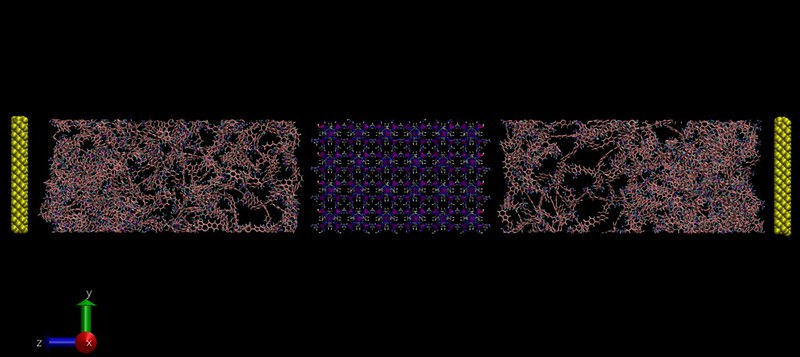
09. Polymer/MOF Mixed Matrix Membrane Equilibration
Tiziano Cavalieri, University of Edinburgh, School of Engineering
The Focus of this work is to investigate, from an atomistic point of view, the structure-properties relations of mixed matrix membranes made of polymers and metal organic framework nanoparticles in the context of gas separation applications. The video shows a system representative of a mixed matrix membrane made of Matrimid polymer and metal organic framework ZIF-8. The polymeric phase is located at both ends of a ZIF-8 slab situated in the middle of the simulation box and at the left and right of this system there are two repulsive walls. The video shows the equilibration of the membrane carried out by progressive cooling and compression/decompression stages until reaching ambient temperature.
The simulation has been carried out using LAMMPS open-source software on Archer2, using classical MD for a total of 6 nanoseconds. The Video has been created using VMD open-source software for the rendering of the mixed matrix membrane system.

10. Nanostructured sulfur as promising battery materials
Dr Ruitian He, University of Oxford, Department of Engineering Science
Sulfur-based nanomaterials are promising cathode materials for next-generation batteries, due to their exceptionally high theoretical capacity and energy density. The fundamental electrochemical reactions of sulfur ring (S8) underpin battery operation, yet their underlying mechanisms remain unclear.
This image presents the nanostructure of pure sulfur, which comprises six sulfur rings, each consisting of eight sulfur atoms (yellow) connected by S-S bond (green). The sulfur materials and their electrochemical mechanisms have been studied via scalable quantum mechanics (cp2k) and molecular dynamics simulations (LAMMPS) on ARCHER2.
11. Newly Discovered Wake Regimes Enabled by Permeability
Doudou Huang, University of Edinburgh, School of Engineering
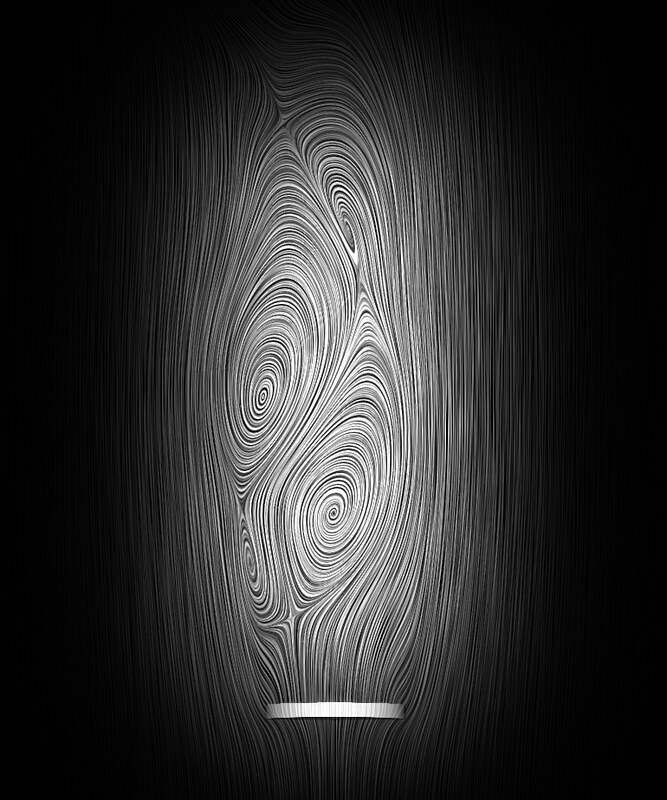
Permeable disks are relevant to a wide range of natural and engineering applications. The plumed diaspore of the dandelion seed and filamentous micro-flyers inspired by this natural design can be simplified as permeable disks. Using numerical simulations on ARCHER2, we classify the wakes behind permeable disks at low to moderate Reynolds numbers and identify three new flow regimes: the separated vortex ring (SVR) breathing, intermittency and periodic SVR splitting regimes. The video shows these three new wake regimes, visualised using the Surface LIC (line integral convolution) representation in ParaView. Our findings show that small variations in permeability can fundamentally alter wake dynamics and introduce intrinsic unsteadiness that does not occur behind an impervious disk. The results therefore provide new insight into passive wake control using porous materials and are also significant for understanding natural filamentous flyers and informing the design and control of nature-inspired filamentous flyers for environmental monitoring.

12. From instability to turbulence in buoyancy-aided channel flows
Dr William Ismael Machaca Abregu, Imperial College London, Department of Aeronautics
This image captures the transition from a laminar flow (left) to a turbulent state (right) in a heated vertical buoyancy-aided channel flow, a process relevant to nuclear reactors. The simulation was performed on the ARCHER2 national supercomputer using the Xcompact3D code. Linear stability analysis was employed to identify the most unstable flow perturbations, which were introduced to trigger the transition.
The evolution of the vortex structures is shown from left to right in time, revealing the emergence of complex coherent structures, including quasi-hairpin vortices. This high-fidelity simulation provides new insights into the mechanisms governing thermally driven flows, where buoyancy affects flow stability, heat transfer, and pressure losses.

13. High-resolution atmospheric dynamics over Southern Africa
* * * Winning Early Career entry * * *
Dr Fran Morris, University of Oxford, School of Geography and the Environment
The video shows the evolution of potential vorticity, a measure combining local wind rotation and atmospheric profile stability, on a 300 hectopascal pressure surface. The output is from a high-resolution "convective-scale" simulation of the atmosphere over Southern and Eastern Africa, run using the Met Office's Unified Model on ARCHER2. Large swirls in the south are Rossby waves propagating into the domain: these dominate variability in weather over Southern Africa. To the north, over central Africa, small-scale dipoles of potential vorticity erupt and coalesce into large, organised thunderstorms which propagate for days at a time and bring rain across the continent. Later, these small dipoles become embedded in the larger Rossby wave structures, forming cloud bands which bring rainfall on large scales across Southern Africa.

14. Tracking thunderstorms over Southern Africa
Dr Fran Morris, University of Oxford, School of Geography and the Environment
The video shows a mesoscale convective system: a large, long-lived thunderstorm. Its shape is shown as the cloud at the top of the atmosphere, and its track is shown as the navy line tracing over the orography of southern Africa. The continent is shaded to represent soil moisture, with the green representing a wetter surface. Below the cloud, red and blue surfaces show rotating and counter-rotating atmospheric structures, and grey columns indicate location of precipitation.

15. Inside a turbulent hydrogen flame: a large-scale simulation reveals the intricate cellular structures hidden across its surface.
Dr Xinyi Chen, Newcastle University
Hydrogen could play an important role in future low-carbon energy systems, powering gas turbines for electricity generation and propulsion without producing carbon dioxide when burned. Yet hydrogen flames are exceptionally fast and highly sensitive to turbulent motion, making them difficult to predict and control.
Using ARCHER2, we performed a large-scale three-dimensional simulation to look inside a turbulent hydrogen flame in extraordinary detail. The main image captures a bowl-shaped flame suspended in a gently swirling flow: fiery colours show its temperature, while blue structures reveal the turbulent vortices that shape it. The accompanying close-up acts like a microscope, revealing a hidden landscape of intricate cellular structures across the flame surface, created by the interaction between turbulence and hydrogen combustion. By resolving these tiny structures while simultaneously capturing the entire combustion chamber, ARCHER2 allows us to connect fundamental flame physics with the challenge of developing cleaner and safer hydrogen combustion technologies.
16. β-amyloid 42 oligomer unfolds and blocks the α-7 nicotinic acetylcholine receptor
Dhanushika Wannaku Mudiyanselage, University of Kingston, Faculty of Health, Science, Social Care & Education
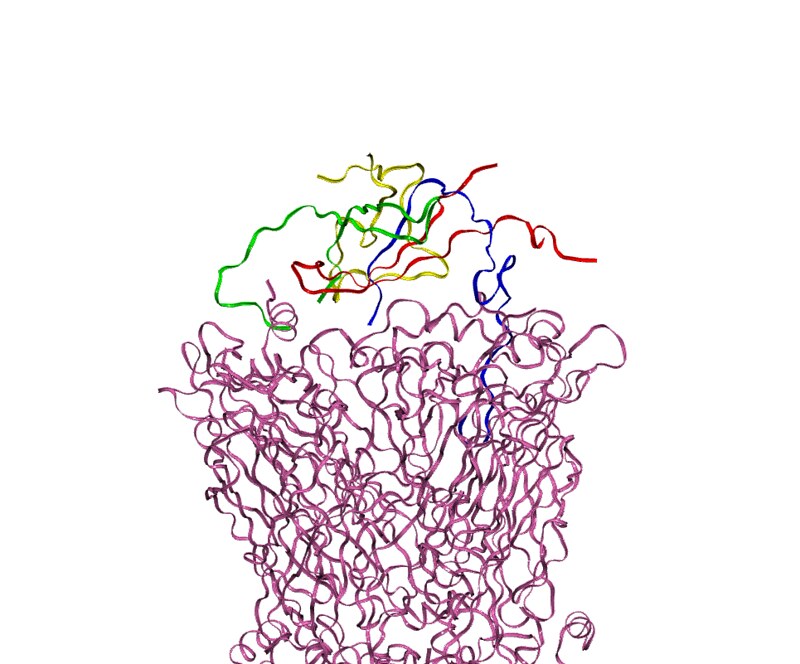
This video shows a molecular dynamics simulation of a beta-amyloid 42 oligomer unfolding and blocking an alpha-7 nicotinic acetylcholine receptor (pink) found on neuronal membranes. The oligomer is in the form of a tetramer (4, 42 amino acid chains in red, yellow, blue and green) and loses its beta-sheet structure becoming jumbled, sticky and yarn-like. It spontaneously attracts and binds to the surface of the receptor, blocking entry to neurotransmitters, cell signalling and normal conformational changes to open and close. This behaviour may explain the synaptic loss and neural degeneration found in neurodegenerative diseases like Alzheimer's Disease. The simulation was conducted using GROMACS on ARCHER2, and VMD was used for video capture and rendering.
17. Chaos in the Vortex Street: Wake Deflection by a Partially Flexible Trailing Edge
Hibah Saddal, University of Birmingham, Aerospace Engineering
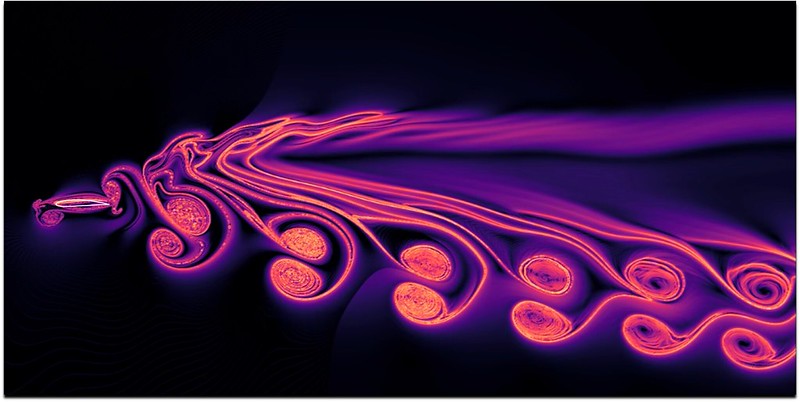
A partially flexible airfoil, with a compliant trailing edge, produces a distinctly asymmetric wake through two way coupled fluid structure interaction. As the fluid flow interacts with the sinusoidally plunging airfoil, deformation of the flexible trailing-edge modifies vortex shedding, generating a downward deflected wake with periodic vortex pairs and a coherent propagating vortex trail. Capturing this fluid-structure interaction required high-fidelity simulations on the ARCHER2 HPC system, coupling OpenFOAM, a finite-volume method based fluid solver, with CalculiX, a finite-element method based structural solver. The flow field is then visualised in terms of the negative finite-time Lyapunov exponent ridges, providing a means of identifying the underlying coherent structures within the wake.

18. Bending with the Vortex: Morphing Response of a Foil with Graded Chordwise Flexibility to a Vortical Gust
Hibah Saddal, University of Birmingham, Aerospace Engineering
An airfoil with graded chordwise flexibility, transitioning from a rigid leading-edge to a flexible trailing-edge through multiple chordwise segments, is subjected to a spatial gust. Snapshots of the fluid-structure interaction over time show deformation of the flexible trailing-edge in response to the vortical gust. Passive morphing can mitigate the effects of gust disturbances, leading to improved aerodynamic efficiency relative to a rigid configuration. Capturing this coupled fluid-structure interaction required high-fidelity simulations on the ARCHER2 HPC system, using a partitioned approach that couples the fluid solver OpenFOAM (finite-volume method), with the solid solver CalculiX (finite-element method). The resulting flow field is then visualised in terms of the negative finite-time Lyapunov exponent ridges, allowing visualisation of the underlying flow structures and their evolution during the gust-airfoil interaction.